
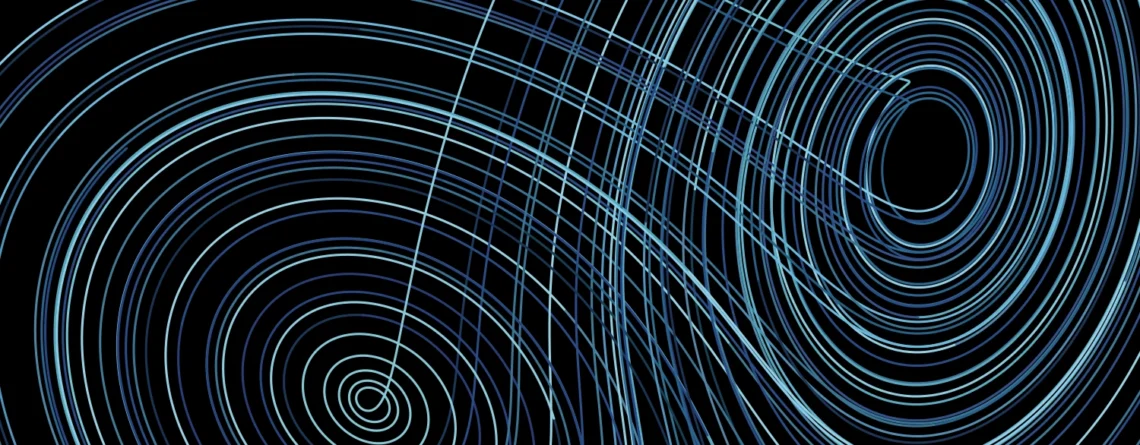
Chaos theory might sound like mathematical anarchy, but it is actually about uncovering the surprising, often beautiful, order within apparent randomness. By studying complex systems like weather patterns or the stock market, we find that chaos follows fascinating, underlying rules. This field has transformed how we view predictability and structure in the universe.
What is Chaos Theory?
At its heart, chaos theory is a branch of mathematics that studies dynamic systems—systems that change over time—whose long-term behavior is unpredictable, even though they are governed by strict deterministic laws. Unlike simple systems, chaotic systems are non-linear and highly sensitive to initial conditions.
Sensitivity to Initial Conditions: The Butterfly Effect
This concept is chaos theory’s most famous rule: even the smallest, most minute change in the starting point of a system can lead to vastly different outcomes over time. The butterfly effect illustrates this perfectly—a tiny, localized change in atmospheric conditions could theoretically trigger a massive weather event weeks later. This discovery revolutionized fields like meteorology, establishing clear limits on how far into the future we can predict complex natural phenomena.
The Visual Language of Chaos: Fractals and Self-Similarity
Before diving into Attractors, we must touch upon the visual cornerstone of chaos theory: fractal geometry. Fractals are complex geometric shapes that exhibit self-similarity, meaning that a small part of the shape looks identical to the whole, regardless of the level of magnification.
This principle of infinite, repeating complexity is found everywhere in the natural world: in the branching of trees, the structure of Romanesco broccoli, the path of lightning, and the intricate patterns of snowflakes. Fractals demonstrate that highly complex and beautiful natural forms can be generated from very simple mathematical formulas. The study of fractals reinforces the central idea of chaos theory: hidden order lies beneath apparent disorder.
Explore the Principle: If you appreciate the complex, repeating beauty found in chaotic systems, explore our Chaos Theory Prints where we visualize these infinitely detailed mathematical forms.
Strange Attractors: Where Predictable Order Emerges
Strange Attractors are key mathematical structures that describe how a chaotic dynamic system evolves over time. While the path of the system itself is unpredictable, its behavior is contained within the boundaries of the attractor. These intricate, non-repeating structures are the mathematical proof that even chaos has defined limits and a profound structural elegance.
Chaos theory might sound like mathematical anarchy, but it is actually about uncovering the surprising, often beautiful, order within apparent randomness. By studying complex systems like weather patterns or the stock market, we find that chaos follows fascinating, underlying rules. At Meloprints, we transform those mathematical rules into striking visual art.
Lorenz Attractor
The Lorenz attractor was discovered in the 1960s by meteorologist Edward Lorenz while he was running simulations of weather patterns. His accidental discovery of the sensitive dependence on initial conditions changed the course of dynamical systems research.
Scientific Impact: The attractor is generated by three non-linear differential equations that model atmospheric convection. Its iconic, butterfly-like shape provides a visual model for all systems that are deterministic yet non-periodic. The Lorenz attractor has applications not just in weather prediction but also in fluid dynamics, laser physics, and complex electrical circuits. The sheer complexity required to visualize this pattern makes it a powerful artistic subject.
The mathematics of this chaotic system is a profound symbol of unpredictability and order.
Shop the Lorenz Attractor

Rössler Attractor
The Rössler attractor was discovered by German biochemist Otto Rössler in 1976. Unlike the Lorenz attractor, the Rössler system is slightly simpler and models dynamics in continuous time, often making it easier for researchers to study the fundamental properties of chaos.
Scientific Impact: Due to its structure, the Rössler attractor is commonly used to model biological rhythms, such as those seen in cardiac cycles, and certain oscillating chemical reactions. The system showcases a transition from simple periodic behavior into complex chaos, which is frequently observed in natural phenomena. The resulting visual form, characterized by its looping, evolving path, highlights the aesthetic component inherent in chaotic mathematics.
Shop the Rössler AttractorThree-Scroll Unified Chaotic System
This is an advanced mathematical model that merges characteristics from multiple chaotic systems into a comprehensive framework, often described by three coupled nonlinear differential equations. Its discovery allowed researchers to study complex dynamics using a single, unified reference point.
Scientific Impact: The visual representation of this system is striking, often appearing as three distinct scrolls intertwined in space. It is a key tool for researchers studying complex behaviors in electrical engineering, advanced fluid dynamics, and secure communications, where predicting and managing chaotic motion is essential. The complex and layered appearance of the three scrolls is a fascinating subject for high-detail visualization.
Shop the Chaos Theory

Halvorsen Attractor
The Halvorsen attractor is a chaotic system defined by a unique set of three nonlinear differential equations discovered by Norwegian scientist Hans Halvorsen. It is a more recently discovered member of the Strange Attractor family.
Scientific Impact: It is characterized by swirling, interconnected loops that resemble the Rössler attractor but with distinct and more complex symmetries. Researchers utilize the Halvorsen attractor in various physical simulations, especially in secure communication protocols, where its sensitive dependence on initial conditions makes it suitable for encryption methods. The complex, interwoven paths of this attractor highlight the depth of mathematical discovery in the field of chaos.
Shop the Strange AttractorsTransforming Chaos into Wall Art
Chaos theory isn’t just about formulas—it’s about understanding the deep, hidden architecture of the universe. Strange attractors are the beautiful, tangible evidence of this, making complex science accessible through visual form.
If you are captivated by the elegance of these hidden structures, check out our collection of Chaos Theory Prints and bring a touch of science-inspired beauty into your home.